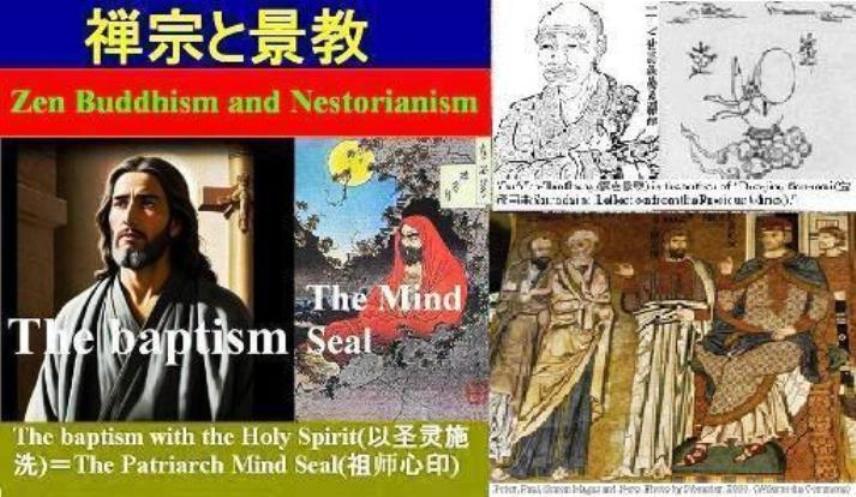
Zen Buddhism and Nestorianism Series 22:One's own teacher
<◆Zen Buddhism and Nestorianism Series 22:One's own teacher>
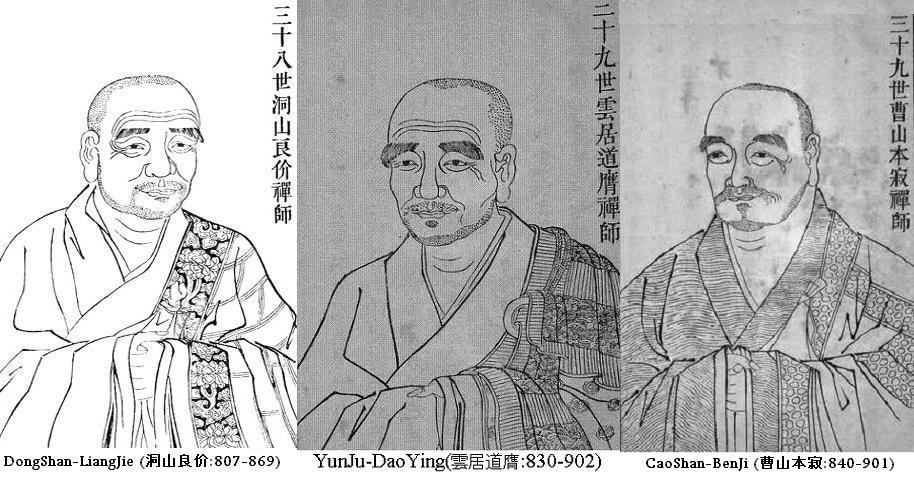
By the end of DaZhong period (847-859) of the Tang dynasty, Chan Master DongShan LiangJie (洞山良价807-869) received disciples and taught them at the XinFeng Mountain. After that his teachings were wide-spread at DongShan in GaoAn of YuZhang (Present northern area of Yinfeng County in Jiangxi Province).
One's own teacher
One day, when the Master was conducting the annual memorial service for Master YunYan, a monk asked him: "What instruction did you receive from the late Master YunYan?"
"Although I was there with him, he gave me no instruction." answered the Master.
"Then why should you conduct the memorial service for him, if he did not instruct you?" further asked the monk.
"Although this was the case, how could I disobey him?" explained the Master.
"You became known after you visited NanQuan. Why should you conduct the memorial service for YunYan?" pressed the monk.
"It is neither for his moral character, nor for his teaching of Dharma that I respect him. What I consider to be important is that he never openly told me anything." stated the Master.
The monk then asked him: "Master! you conduct a memorial service for the late Master YunYan.
Do you agree or disagree with what he has said to you?"
"Half agree and half not!" replied the Master.
"Why don't you entirely agree with him?" continued the monk.
"If I entirely agreed with him, it would be ungrateful to him." replied the Master.
A monk asked: "How can I see your original master?"
"If two people both reach the ultimate, then there is no barrier of age between them." answered the Master.
No gratitude to the 'Four Graces' and the 'Three Existences'
The monk tried asking about what still puzzled him. The Master said to him: "Do not trace the previous steps, but raise another question." The monk made no answer. YunJu, an elder monk, replied for him: "According to what you say, I cannot see your original master."
The Master then continued: "Is there any one who does not show his gratitude to the 'Four Graces (Heaven/ Earth/ Lord/ Parents)' and the 'Three Existences (Intelligences / Destiny/ Animateness)'." If he does not understand the meaning of these, how can he be free from the suffering of the beginning and ending of existence. Every thought he has in his mind should be free from attachment to things, and also every step he takes should be free from attachment to his dwelling place.
When he keeps on in such a way without interruption, he will be close to the answer."
("The Transmission of the Lamp, Chapter 15" translated by Chang Chung-Yuan)
The path to YunYan is going to be cut off
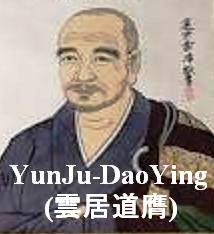
Much later, Master DongShan got sick. He sent a young monk to inform YunJu-DaoYing(雲居道膺:830-902), the head of his disciples. He told the monk that if YunJu should ask for his words, he should tell him this: "The path to YunYan (雲岩) is going to be cut off." DongShan also warned his messenger that while speaking to YunJu he should stand far away from him, so that YunJu would not strike him. However, when monk took the message to YunJu, he was struck even before finishing his words. The monk fell silent.
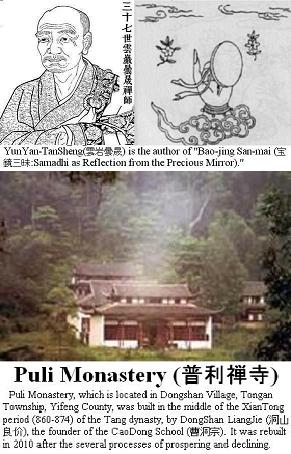
YunYan is the master of DongShan-LiangJie and his full name is YunYan-TanSheng(雲岩曇晟:782-841) and is the author of "Bao-jing San-mai (宝鏡三昧:Samadhi as Reflection from the Precious Mirror)," which has been handed down from generation to generation in the CaoDong School.
Who is the Young Monk?
By the way, there are several mysterious points in the series of interactions among the three people, DongShan, the young monk and YunJu. First of all, why did DongShan send such message, saying "The path to YunYan is going to be cut off"? Secondly, DongShan knew that YunJu would beat down the messenger. Thirdly why should the messenger be beaten down? Fourthly, why was the messenger beaten down even though he had known in advance to be beaten and why did not he say a single word?
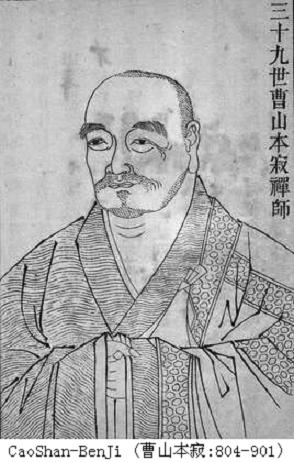
One possible answer is that the young monk was CaoShan-BenJi himself. It means that DongShan had already decided to make CaoShan his successor at that point. In other words, DongShan had decided to entrust him with the position of the High Priest of DongShan Temple at XinFengShan (Current TaiPing Township, YiFeng Prefecture, Jiangxi Province) after his death. And YunJu also knew about it. As of DongShan's death in 869 AD, it is believed that DongShan was 62 years old, YunJu was 39, and CaoShan was 29. As a successor, it is no wonder that CaoShan, who was younger than YunJu, was seen to be more suitable for long term. (In fact, it seems that CaoShan died one year earlier than YunJu.) However, CaoShan still might have been identified the lack of capability to undertake this role. Thus, DongShan not only ordered CaoShan to tell YunJu "The path to YunYan is going to be cut off," but also said to CaoShan, "If you tell YunJu this, he would beat you up. So you must be prepared." As such, CaoShan could not escape anywhere. If he escaped, he would have abandoned himself to become a successor of DongShan. So he seems to have left himself to be beaten and have not said a single word.
Fictitious name
Now, DongShan, who realized that the day of reckoning for him was coming, one day delivered a sermon to the congregation and asked, "I have made a fictitious name in this world. Who will remove it for me?"
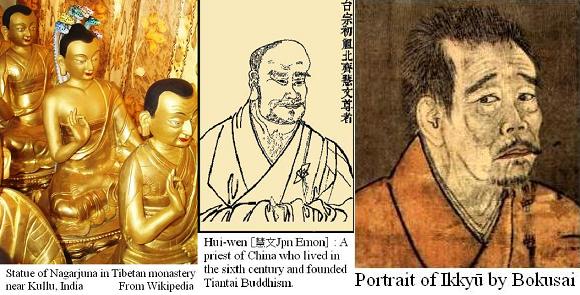
In this world, individual events and things perceived by men through their five senses are merely provisional names given to each process of changes. Thus they are called the temporary name. Indian Buddhist philosopher Nagarjuna (150?-250?) described this theory in his book "The Treatise on the Middle Way" and stated: "Dharmas (phenomena) are born of causes and conditions. I say they are thus empty. They are also called the temporary name, and that is also the truth of the Middle Way." During Wei, Jin, and Southern and Northern Dynasties period (220-589 CE) of China, Hui-wen (550-577), the founder of Tiantai Buddhism, who read this verse and at once perceived the triple truth, namely, the truth of emptiness, the truth of temporariness and the truth of mean, explained as follows. These three - emptiness, temporariness and mean - penetrate one another and are found perfectly harmonized and united. One should not consider the three truths as separate but as the perfectly harmonious three fold truth.
Hence DongShan said, "If I die, 'DongShan-LiangJie' will be merely fictitious name which has no substance. If it will be left alone, it will walk alone and may create some problems for the future generations. Who will remove it for me?" In this regard, Japan's leading Zen monk, Ikkyu Sojun (一休宗純: 1394-1481) composed following comic tanka poem, "Shakamuni, That mischievous creature, Having appeared in the world, Misled, alas, How many people! (Shaka to iu itazura mono ga yo ni idete ohku no hito wo mayowasuru kana)"
Dharma title
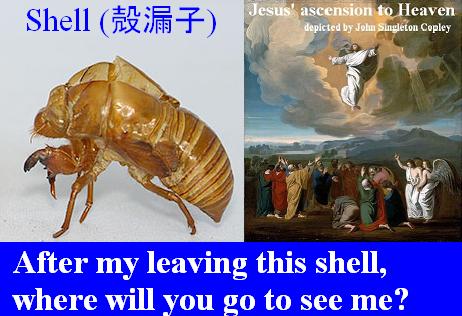
The disciples present looked at each other in a timid manner and none of them responded. But after a while a novice stepped forward and said: "Please tell us your Dharma title." He meant "If 'DongShan LiangJie' is temporary name, then can you tell me Dharma title which symbolizes the absolute truth transcending space and time." Then DongShan answered, "Attaboy! My fictitious name has already faded away." This novice also seems to have been CaoShan. If so, it is agreeable that DongShan was in a good mood. And DongShan added, "After my leaving this shell, where will you go to see me?" However, all the disciples were silent.
In living to work hard; in death to be at rest
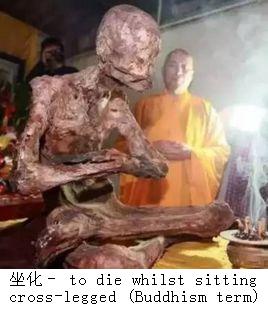
One day, in the third month of the tenth year of the XianTong (咸通) period (March 869 AD), Master DongShan LiangJie, having had his head shaved and having put on his robe, ordered the gong struck. He was going to pass away by sitting solemnly.
In the meantime all his disciples were crying and deeply moved. After a while the Master suddenly opened his eyes and stood up, and spoke to the assembly: "Those who are Buddhists should not attach themselves to externalities. This is the real self-cultivation. In living they work hard; in death they are at rest. Why should there be any grief?" Thus a lesson was given to those who clung to passion. However, all his disciples were still yearning for him. Seven days passed and on the last day after completing memorial service ritual the Master said to them: "When a Buddhist behaves, he should not be heedless. What a noise and disturbance you made, when I started my departure!" He might feel that it was too exalted farewell. So he said to them, "Too noisy, That's enough. I am difficult to die." And he ordered them "Behave like Zen monks!"
On the eighth day after bathing he sat still and passed away. His age was sixty-three. It was forty-two years after he was ordained. His posthumous name bestowed by the Court was Great Master WuBen (悟本大師), and his pagoda was entitled HuiJue (慧覚). (Hensho: 2018-07-18)
Comment by Zen Master Dogen
Regarding Zen master YunJu-DaoYing, Dogen Zenji(道元禅師:1200-1253), the founder of the Japanese Soto Zen School(曹洞宗), is commenting in the 'way of the Buddha (仏道)' section of his 'Shobogenzo (正法眼蔵)' as follows; "The name 'CaoDong sect (曹洞宗)' may have derived from someone adding CaoShan (曹山)'s name to DongShan(洞山)'s. If this is so, then YunJu and TongAn(同安) should also have been included. YunJu was a guiding Master among ordinary people, as well as among those in loftier positions, and was even more revered than CaoShan. When it comes to this name 'CaoDong', clearly some stinking skin bag in an offshoot lineage who fancied himself the equal of DongShan devised the name 'CaoDong sect.' While it is convincing that Dogen Zenji, who belonged to dharma lineage of YunJu-DaoYing and his disciple TongAn-DaoPi(同安道丕:?-905), more revered YunJu-DaoYing than CaoShan-BenJi (曹山本寂:840-901), but it seems to be somewhat improper to say that the name 'CaoDong,' clearly some stinking skin bag in an offshoot lineage who fancied himself the equal of DongShan devised the name 'CaoDong sect.'
John the Baptist and the sect of Simonians
While Jesus borrowed a few disciples from John the Baptist and started his missionary work, latter's other disciples also seem to have joined Jesus' missionary work after the death of John the Baptist. (John 10:40-42)
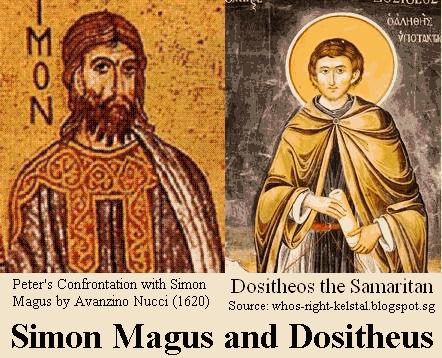
According to so called "Clementine literature," a series of documents written by perhaps multiple authors in the name of Pope Clement I, John the Baptist had thirty leading disciples. The first and most esteemed by John was Simon. But on the death of John he was away in Egypt and one Dositheus succeeded in installing himself as head of the sect. After Simon's coming back, Dositheus asked him, "Tell me if thou art the Standing One, that I may adore thee." And when Simon answered that he was, then Dositheus, perceiving that he himself was not the Standing One, fell down and worshipped him, and gave up his own place as chief to Simon, ordering all the rank of thirty men to obey him; himself taking the inferior place which Simon formerly occupied. Then the sect of Simonians was established.
Simon was a Samaritan, and a native of Gitta. He studied Greek literature in Alexandria, and, having in addition to this great power in magic, became so ambitious that he wished to be considered a highest power, higher even than the God who created the world. And sometimes he "darkly hinted" that he himself was Christ, calling himself the Standing One. Which name he used to indicate that he would stand for ever, and had no cause in him for bodily decay. He did not believe that the God who created the world was the highest, nor that the dead would rise. He denied Jerusalem, and introduced Mount Gerizim in its stead. In place of the Christ of the Christians he proclaimed himself; and the Law he allegorized in accordance with his own preconceptions. He did indeed preach righteousness and judgment to come.
Simonism and Pauline Theology
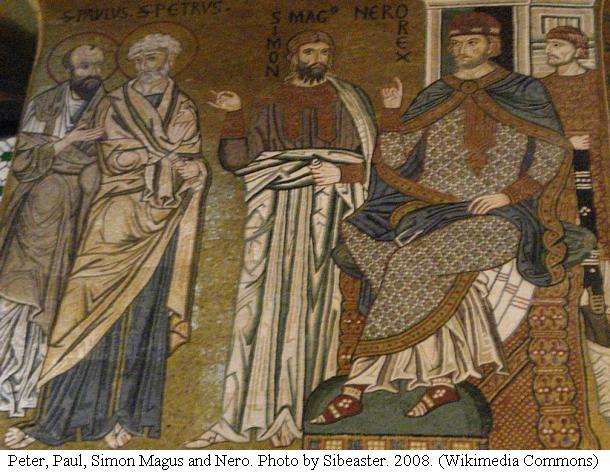
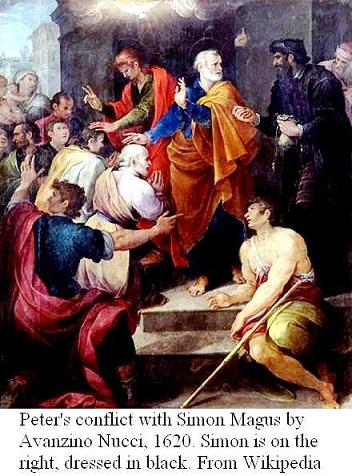
Simon Magus, who had tried to join the church movement and asked to give him status of the Apostle just as St. Paul but had been refused by St. Peter (Acts 8:9-24), is said to have come up to Rome later and have been appointed by Emperor Nero as his religious adviser.
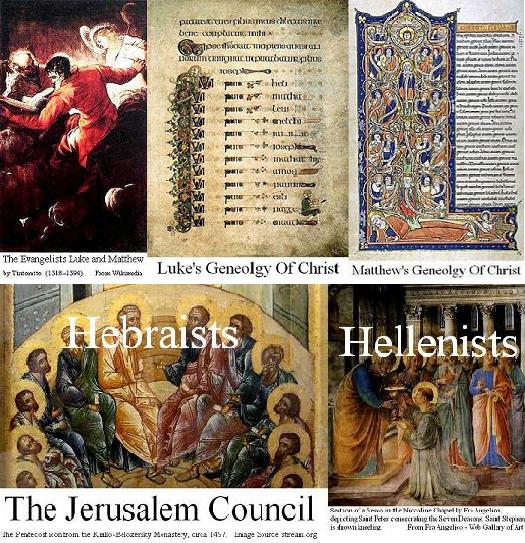
It seems that the status of apostle requested by Simon apparently refers to the authority to perform ceremonies to baptize new comers with the Holy Spirit. He himself joined the Church movement under the leadership of The Jerusalem Church through being baptized with water by Philip, one of the Hellenist leaders expelled outside of Jerusalem city after the Stephen incident. The authority to baptize with the Holy Spirit was only given to the Twelve Apostles at that time. Apart from the Twelve Apostles, it seems that only St. Paul and St. Barnabas were later admitted to exercise this authority.
In his book, Apologies, Justin Martyr (100? - 162?) says, "He performed such signs by magic acts during the reign of Claudius that he was regarded as a god and honored with a statue on the island in the Tiber which the two bridges cross, with the inscription Simoni Deo Sancto, 'To Simon the Holy God'" (Apologia, XXVI).
Similarities between Simon and Paul
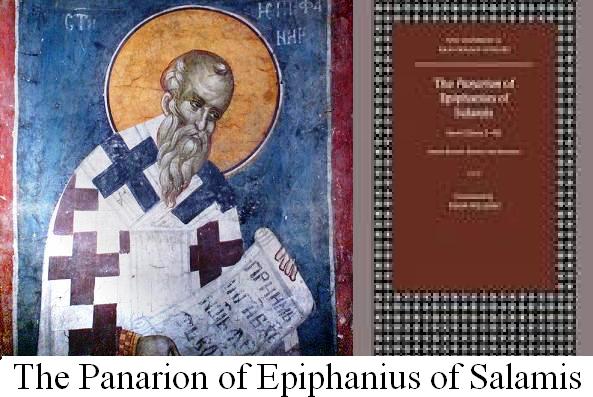
Epiphanius of Salamis also makes Simon speak in the first person in several places in his Panarion, "... for men were saved according to his grace, but not according to just works. For works were not just by nature, but only by convention, in accordance with the enactments of the world-creating angels, who by precepts of this kind sought to bring men into slavery." This passage is somewhat reminiscent of the dogma of "justification by one's faith" which forms a core of Pauline Theology.
According to Epiphanius, Simon taught that both the Law and the prophets were not of God, but of "the sinister power. Thus it was spiritual death to believe in the Old Testament. Yet, Jesus says, "God is spirit, and his worshipers must worship in spirit and in truth."(John 4:24) And St. Paul also says in his letter to his followers, "But people who aren't spiritual can't receive these truths from God's Spirit. It all sounds foolish to them and they can't understand it, for only those who are spiritual can understand what the Spirit means."(1 Corinthians 2:14)
The anti-Pauline characteristic in the Pseudo-Clementines
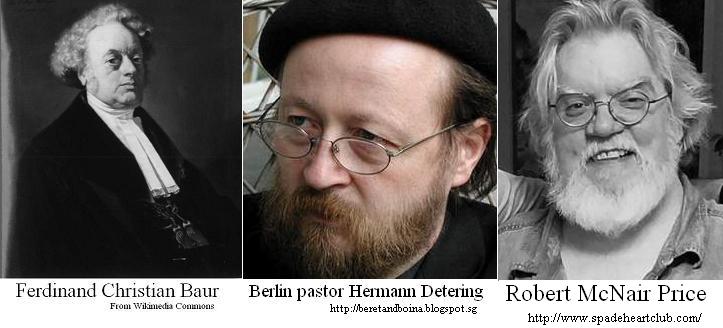
Ferdinand Christian Baur (1792–1860), founder of the Tübingen School, drew attention to the anti-Pauline characteristic in the Pseudo-Clementines, and pointed out that in the disputations between Simon and Peter, some of the claims Simon is represented as making (e.g. that of having seen the Lord, though not in his lifetime, yet subsequently in vision) were really the claims of Paul; and urged that Peter's refutation of Simon was in some places intended as a polemic against Paul. The enmity between Peter and Simon is clearly shown. Simon's magical powers are juxtaposed with Peter's powers in order to express Peter's authority over Simon through the power of prayer, and in the 17th Homily, the identification of Paul with Simon Magus is effected. Simon is there made to maintain that he has a better knowledge of the mind of Jesus than the disciples, who had seen and conversed with Jesus in person. His reason for this strange assertion is that visions are superior to waking reality, as divine is superior to human. Peter has much to say in reply to this, but the passage which mainly concerns us is as follows:
Peter's criticism against Pauline Theology
But can any one be educated for teaching by vision? And if you shall say, "It is possible," why did the Teacher remain and converse with waking men for a whole year? And how can we believe you even as to the fact that he appeared to you? And how can he have appeared to you seeing that your sentiments are opposed to his teaching? But if you were seen and taught by him for a single hour, and so became an apostle, then preach his words, expound his meaning, love his apostles, fight not with me who had converse with him. For it is against a solid rock, the foundation-stone of the Church, that you have opposed yourself in opposing me. If you were not an adversary, you would not be slandering me and reviling the preaching that is given through me, in order that, as I heard myself in person from the Lord, when I speak I may not be believed, as though forsooth it were I who was condemned and I who was reprobate. Or, if you call me condemned, you are accusing God who revealed the Christ to me, and are inveighing against Him who called me blessed on the ground of the revelation. But if indeed you truly wish to work along with the truth, learn first from us what we learnt from Him, and when you have become a disciple of truth, become our fellow-workman.
Recently, Berlin pastor Hermann Detering (1995) has made the case that the veiled anti-Pauline stance of the Pseudo-Clementines has historical roots, that the Acts 8 encounter between Simon the magician and Peter is itself based on the conflict between Peter and Paul. Detering's belief has not found general support among scholars, but Robert M. Price argues much the same case in The Amazing Colossal Apostle: The Search for the Historical Paul (2012). (Extract from English Wiki)
The composition of conflict between Hebraists and Hellenists
'The Gospel of Matthew' contains a hard to understand and objectionable passage as follows; "From the days of John the Baptist until now, the kingdom of heaven has been forcefully advancing, and forceful men lay hold of it. (Mat 11:12)"
There is certainly a similar parallel article also in 'the Gospel of Luke.' But Jesus says abruptly in a different scene, "The Law and the Prophets were proclaimed until John. Since that time, the good news of the kingdom of God is being preached, and everyone is forcing his way into it. (Luke 16:16)" Against the same phenomenon that occurred after John the Baptist, while the Gospel of Matthew is alarming that the kingdom is attacked and is in imminent danger, but the Gospel of Luke celebrates that those who heard the gospel are rushing into the kingdom.
Apparently, the statement in 'the Gospel of Luke,' saying, "The Law and the Prophets were proclaimed until John. Since that time, the good news of the kingdom of God is being preached, and everyone is forcing his way into it (Luke 16:16)," seems to indicate the group of the Gentile Church led by Paul and Luke itself, in other words, believers of Jesus not after the flesh. So these parallel articles of Gospel of Matthew and Luke symbolize the composition of conflict between Hebraists and Hellenists
Reconciliation
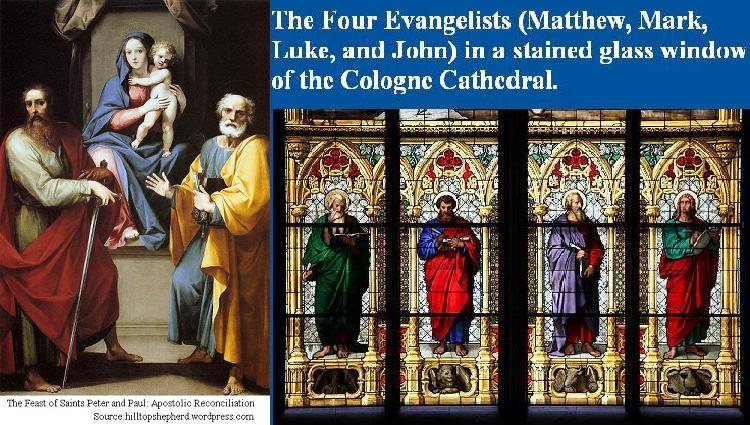
The conflict between Hellenists (non-circumcision believers) and Hebraists (circumcision believers) in the Gentile Church persisted after the death of Paul and disappearance of the Jerusalem Church. Perhaps as a result of this, neither James nor Paul, but Peter was canonized as the first Pope of Roman Church. However, the Christian church has overcome such hostility and confrontation since the 4th century and those four Gospels — Matthew, Mark, Luke and John — have come as the canon of the New Testament.
What is "Baptism with The Holy Spirit"?
According to the dialectic of the Gospel of John,
【Thesis】"A man can possess eternal life through accepting testimony of the Son of man and being baptized by him." (John 5:24)
【Anti-thesis】But "The one who comes from the earth cannot accept the testimony by one from heaven."(John 3:32)
How then can a man possess eternal life?
【Synthesis】"If you want to be baptized with the Holy Spirit, you can just go back to the word which was with God in the beginning (John 1:1) and certify that God is truthful. (John 3:33)"
When he said, "You are Huichao," Zen Master Fayan thrusted vivid Self in Huichao in front of his eyes.